
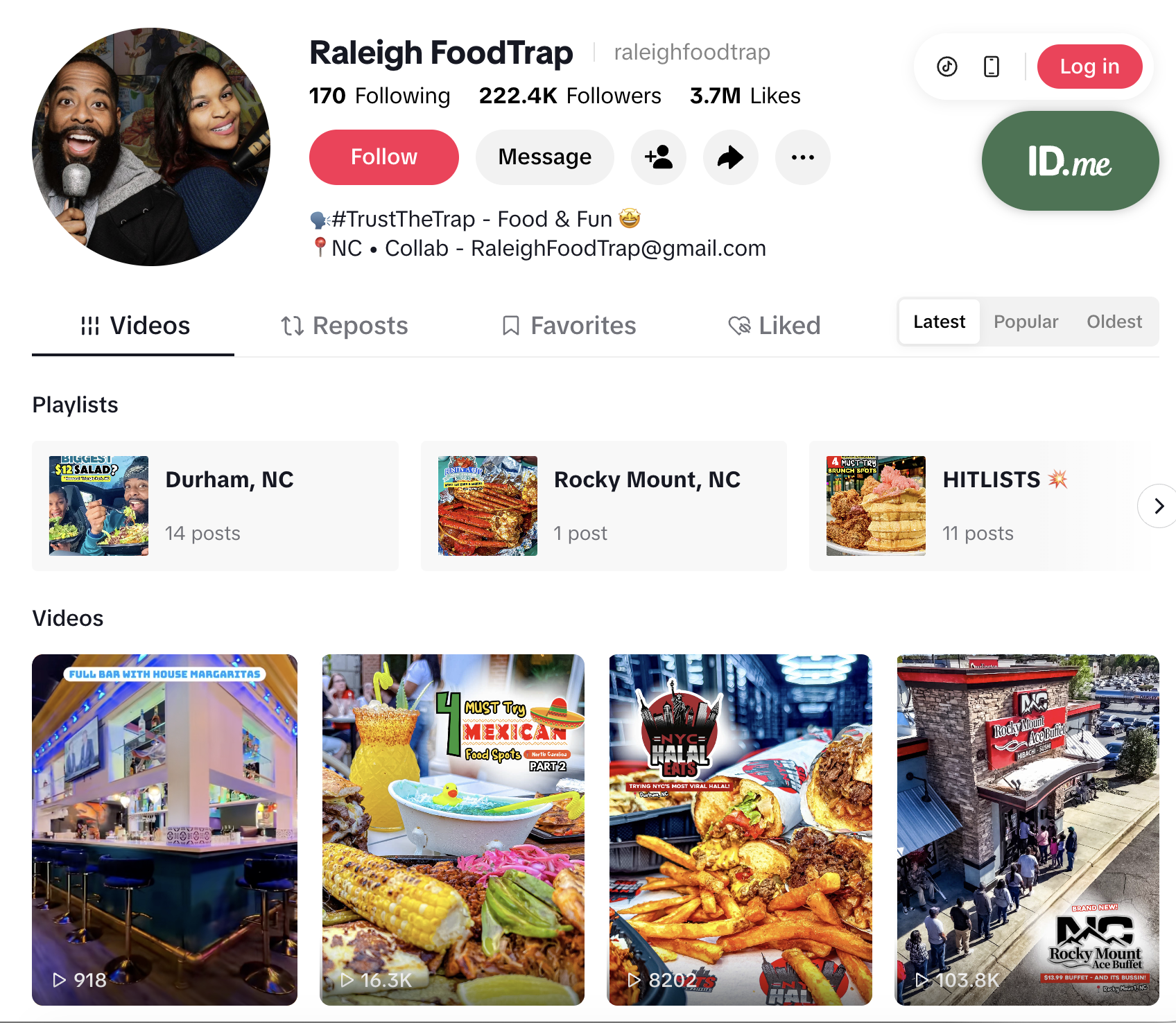
What started as a way to support struggling small businesses during the uncertainty of COVID has grown into something much bigger. Today, Raleigh Food Trap has become a powerful force for connection, visibility, and generosity across local communities. For Wake Forest residents Roger Kornegay and his wife, Briana, it was never about building a following – it was about helping people.
“The Raleigh Food Trap brand started as a way to help small businesses stay open during COVID,” Kornegay shared. “I was a social media manager for Yelp, and when I lost my job, I took those skills and wanted to help local businesses tell their story. So many were closing. We turned to social media to show people it was safe to go out and support them.”
That mission has remained constant, even as their audience has grown to more than half a million followers across platforms. “Helping others has always been my mission,” he said. “It was really birthed from the idea of giving out of my own need. We were helping others sustain while I didn’t even have a job of my own.”
What sets Raleigh Food Trap apart is how seamlessly it blends food, storytelling, and generosity. Through their content, they spotlight locally owned businesses, often focusing on those that need an extra boost. “We love promoting local, homegrown businesses. We love the underdog,” Kornegay explained. “I’ve even helped businesses that were on the verge of closing. If they have great food, a great experience, or something people should know about, we want to tell that story.”
That storytelling translates into real results.
“With our platform, you’re talking about over half a million people, many of them local,” he said. “We’ve seen businesses sell out in record time after a post. Some have been able to open new locations or upgrade their operations because of the support they received.”
One example close to home is Jeff's Bagel Run in Wake Forest. “Our post received over 1,100 shares in just a couple of days,” Kornegay said. “It created a level of awareness from people who had never even heard of them before.”

Beyond restaurants, Raleigh Food Trap has introduced a concept that has captured widespread attention: the Capital City Cash Crawl. Originally launched as a simple way to give back, it has grown into a weekly, Instagram-driven scavenger hunt across central North Carolina, where clues lead participants to hidden cash drops throughout the Triangle. The initiative has gained significant momentum, drawing crowds eager to take part, with some locations requiring additional oversight to ensure a safe and positive experience.
“We wanted to do more than just give away products,” Kornegay said. “We started using our own money and teaming up with local businesses to give back monetarily. We planned to do four, and now here we are, 23 weeks later, still going.” Through these events, they have distributed more than $14,000 directly into the hands of community members.
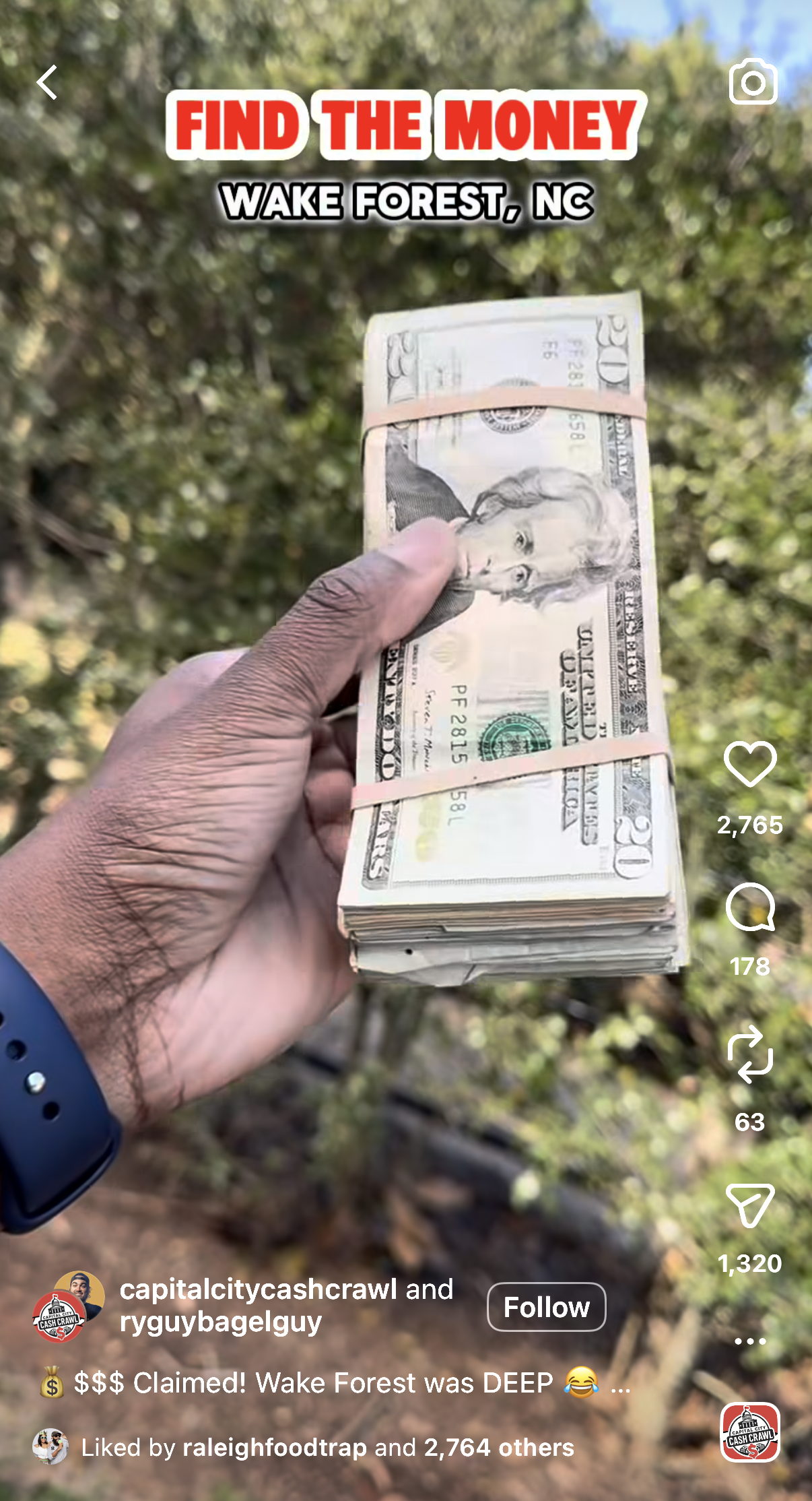
“We’ve heard so many stories,” he said. “One woman told us her lights were about to be turned off, and the money she found was exactly what she needed to keep them on. Another single mom who had lost her job and her car found $1,000. Those moments give us the fuel to keep going.”
It was during one of these cash drops, while briefly stopping at a local park in Wake Forest, that Kornegay connected with Jason Cannon, President of Wake Forest Business and Industry Partnership (WFBIP). What began as a quick conversation about Kornegay’s work quickly turned into a deeper discussion about community impact and the role creators can play in supporting local businesses.
“Communities like Wake Forest benefit from creators like us because we help shape the economic temperature,” Kornegay said. “We’ve posted about places like the Flavor District, and people show up. Lines form. And it doesn’t just help that business. People coming into town stop for gas and visit other shops. It all adds up.”
“What stood out right away was how intentional their approach is,” Cannon said. “It’s not just about creating content, it is about creating momentum for local businesses and encouraging people to engage with their own community in a meaningful way.”
That connection reflects how organically his work intersects with the communities he visits, and it reinforces what he is already seeing happen in Wake Forest. Local spots have already left a strong impression. “We recently visited Il Bacio Italian Grill & Pizza, and it was incredible,” Kornegay said. “It’s a small, locally owned Italian spot with some of the best food you can imagine. The service is warm, the experience is consistent, and you can tell they take pride in what they do.”
As their platform continues to grow, maintaining authenticity remains a top priority. “We protect our voice,” he said. “If a brand wants to script what we say or limit our honesty, we don’t do it. We’ve turned down partnerships because of that. Our audience trusts us, and that matters more.”
That authenticity is also what makes their content resonate in today’s digital landscape. “The billboard isn’t a sign on the highway anymore,” Kornegay said. “It’s content that shows up in your feed. If your business isn’t on platforms like Instagram or TikTok, it’s hard to be discovered.” And while many businesses are eager to “go viral,” Kornegay offers a grounded perspective. “Virality can’t be predicted,” he said. “An account with 500 followers can go viral just like one with 500,000. The key is creating content that provides value. People share what helps them, what excites them, what connects with them.”
At the same time, their commitment to giving back is only growing. “We’re working with a local car lot to give away a vehicle,” Kornegay shared. “Imagine searching through bushes not for money, but for car keys. That’s where we’re headed. And if someone wants to partner with us to give away something even bigger, we’re open to it.”
At its core, the message remains simple. “Supporting local is major,” he said. “When you spend money locally, it stays in the community. It supports families, workers, and future growth. If we don’t support local, all we’re left with are national chains, and nobody wants that.”
For Wake Forest, that message aligns closely with its ongoing momentum. “Creators like Raleigh Food Trap are a powerful example of how storytelling and technology can directly support local businesses,” said Jason Cannon. “By highlighting unique experiences and encouraging people to explore their own communities, they are helping drive real visibility, real traffic, and real economic impact. We are always excited to see new ways our local businesses are being discovered and supported.”
As Raleigh Food Trap continues to grow, its impact remains rooted in something simple: showing up, telling stories, and encouraging people to support what is local. Whether it’s highlighting a hidden gem, creating momentum for a small business, or turning a simple act of generosity into something life-changing, the mission remains the same.
To see where Raleigh Food Trap and the Capital City Cash Crawl are headed next and discover featured businesses across the region, follow along on Instagram, Facebook, and TikTok.