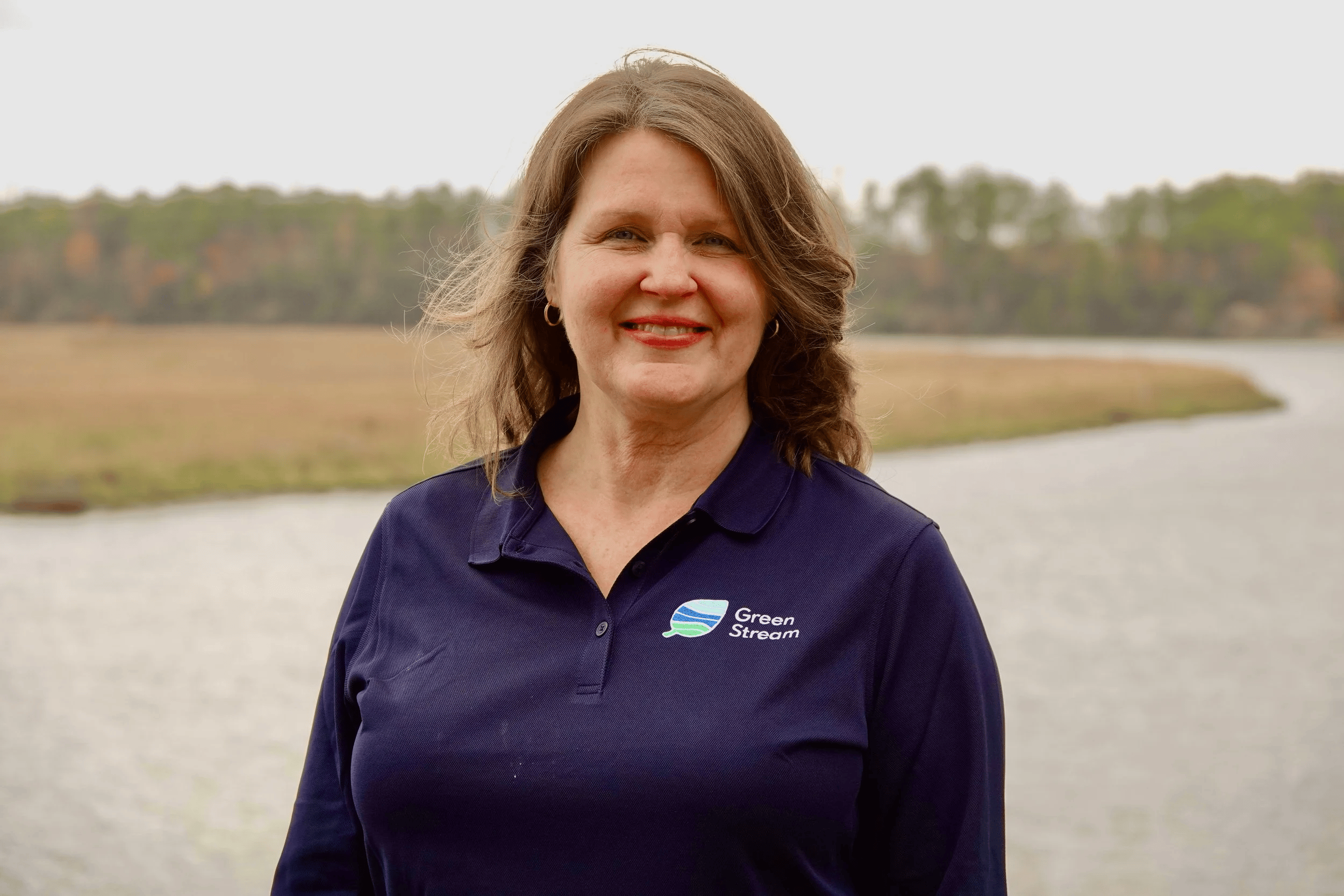
For Karen Lindquist, Wake Forest has become more than a place to do business. It is where Green Stream Technologies found community, built partnerships, and now, in a full-circle moment, is beginning work with the Town of Wake Forest on a flood monitoring project designed to strengthen public safety and long-term planning. Green Stream, headquartered in Wake Forest, provides flood and weather monitoring systems that help communities understand when flooding is occurring, how severe it is becoming, and how conditions are changing in real time. The company’s technology supports state, county, and municipal agencies by delivering data that improves emergency response and localized flood prediction. Lindquist’s path to this work began with both business strategy and personal conviction. Her husband and co-founder, engineer Jim Gray, began developing flood sensors as part of a proof of concept for a customer. Lindquist said she “fell in love with the idea and him,” and saw not only the technical promise of the concept, but also its practical value: “Doing something to combat increasingly severe weather and helping people protect property and safety.”
After considering several technology hubs, including Silicon Valley, Boston, and Northern Virginia, the couple ultimately chose the Triangle, drawn by both its innovation ecosystem and its quality of life. Green Stream later established its headquarters in Wake Forest, where the company found space, relationships, and room to grow. Their collaboration with Wake Forest-based Atlantic Design and Manufacturing, first sparked by a WFBIP newsletter feature, became one example of how local connections can turn into lasting business partnerships.
One of the things she appreciates about Wake Forest, Karen shared, is that sense of community. When she moved here during COVID, she didn’t know anyone. But Jason Cannon with the Wake Forest Business & Industry Partnership (WFBIP) came to meet her, learned about her business, and stayed in touch. When WFBIP launched the Wake Forest Founders Program and specifically its entrepreneurial accelerator, she immediately jumped at the idea, “I wanted to be a part of my community,” Lindquist said. She credits the experience with helping her sharpen how she communicates her business and mission. For Lindquist, “working in a highly technical field made that refinement especially important. The group setting, feedback from fellow entrepreneurs, and the opportunity to test and strengthen my messaging helped Green Stream tell its story more clearly.” Lindquist also noted that the program is especially helpful for entrepreneurs in the early stages of building a business or for solo founders who need feedback, collaboration, and community. Now, that community support is translating into meaningful local impact.
This year, the Town of Wake Forest is launching a pilot project with Green Stream that will begin with three flood gauges and could eventually expand to a network of roughly 12 gauges across the community. According to Town staff, Tim Watson, Engineering Director, and Jessica Watkins, Engineer, “that information can help the Town better understand how streams behave during dry periods and storm events, improve planning for future infrastructure and remediation projects, and strengthen emergency response when roads or low-lying areas become unsafe.” The effort is expected to begin along Smith Creek.
For Lindquist, the Town contract is meaningful not only because of what it represents for Green Stream’s growth, but because it is happening in her own community. She described the partnership as, “an opportunity to bring advanced flood and weather monitoring technology to Wake Forest while also giving the Town a chance to be on the forefront of emerging tools and for Green Stream to test new technologies in its backyard.” Town leaders see the value from both a technical and a human perspective. Watkins picked Karen to partner with specifically, “because Karen and her company are based in Wake Forest, she brought existing knowledge of the area, possible installation points, and the broader community context. That local familiarity, combined with Green Stream’s specialized expertise, made the partnership especially compelling.”
The project also reflects the larger purpose behind Wake Forest Founders. The collective is led by the Wake Forest Business & Industry Partnership, the Wake Forest Area Chamber of Commerce, and The Loading Dock - Wake Forest. Together, the partners support entrepreneurs, startups, and businesses through programming, special events, and the signature accelerator program led by Dr. Tim Flood of the UNC Kenan-Flagler School of Business. The accelerator has continued to expand, and Cohort 5 is set to present this spring at the Wake Forest Founders Semi-Annual Pitch Competition on May 27 at The Loading Dock - Wake Forest.
Jason Cannon, President of WFBIP and the Town’s Economic Development Director, has emphasized that entrepreneurship support is a long-term investment in the community. As Wake Forest Founders continues to grow, Cannon said the program helps make entrepreneurship more visible and more connected in Wake Forest. In his words, “A strong, clear brand signals that Wake Forest takes innovation seriously and is committed to supporting those who want to launch and grow here. That’s what creating an ecosystem is all about.” Karen Lindquist’s story offers a strong example of what that support can look like in practice. A founder relocates to Wake Forest, builds a technology company, joins the first cohort of the local founders program, develops relationships through the community, and ultimately partners with the Town itself. It is this kind of outcome that demonstrates how entrepreneurship benefits not just one company, but the broader community as well. As Wake Forest grows, so does the opportunity to support founders whose ideas solve real problems. Green Stream’s work may focus on flood and weather monitoring, but its story is also about something larger: what happens when innovation, community, and local commitment combine.