“If you fail to plan, you are planning to fail.”
Over the past generation, corporate America has joined the public sector, increasingly working together to address environmental challenges and opportunities. Climate-related disruptions have dominated headlines, and communities and companies are striving to make resilience a cornerstone of their strategic planning.
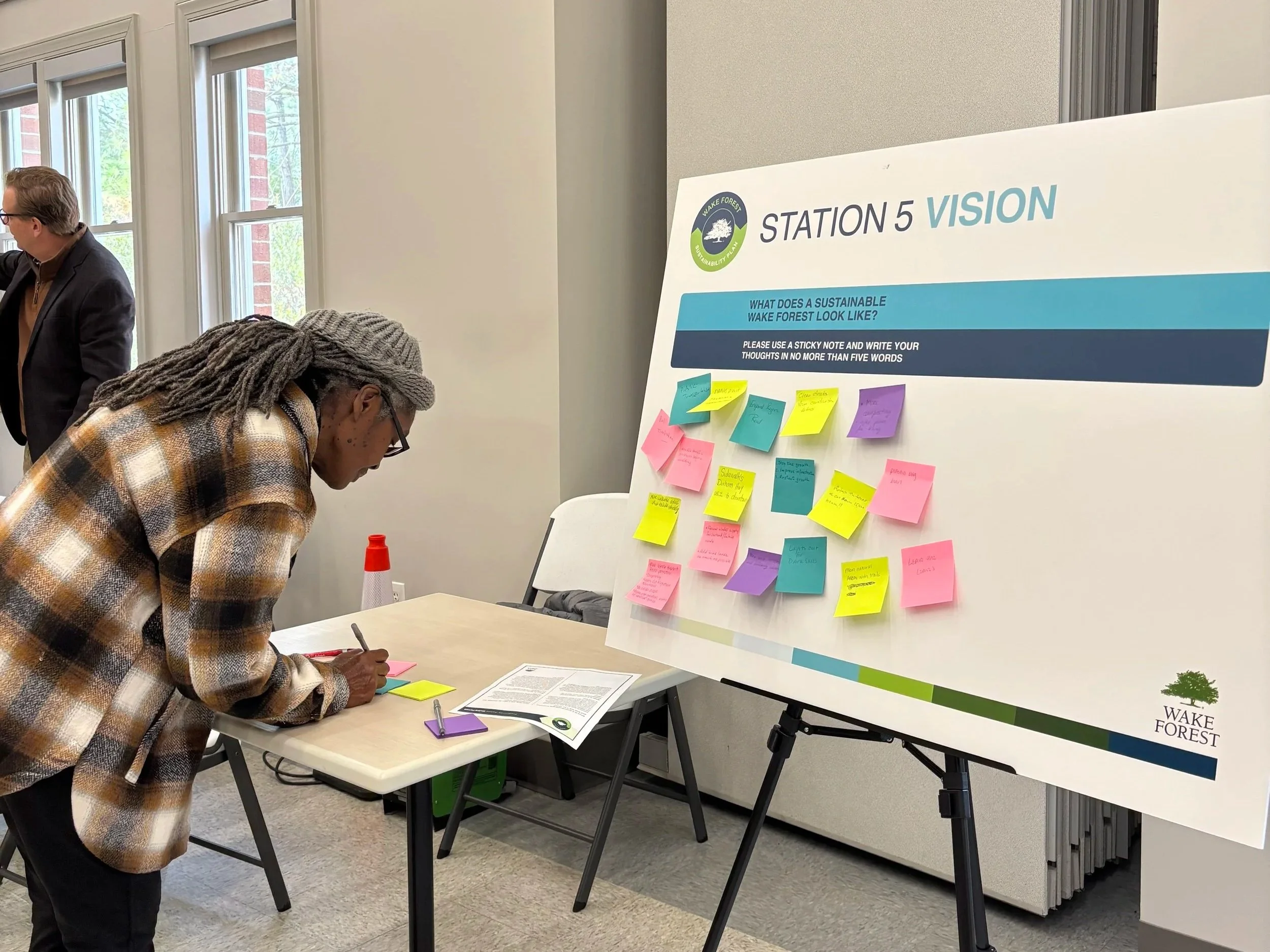
The Town of Wake Forest is engaging in comprehensive planning to identify and address sustainability priorities. In mid-2025, staff drawn from the Town’s Planning, Engineering, Public Works, and Facilities departments began assembling expertise and gathering public input on a sustainability plan targeted for adoption at the end of 2026.
“Investing in Transportation and Infrastructure is Goal 4 of the Town’s Strategic Plan,” explains Lisa Hayes, Director of Organizational Performance for the Town of Wake Forest. “As a high priority under that goal, our Board of Commissioners emphasized the development of a Town-wide Sustainability Plan.”
The Town’s emergence as a popular destination for new residents and businesses underscores the importance of this planning effort, which aims to preserve the assets and amenities that make Wake Forest so appealing. “As Wake Forest continues to grow, having such a plan in place is vital to ensuring long-term environmental protection, quality of life, and economic stability,” Hayes says. “Our commissioners and staff are excited to work with community members, stakeholders, and partners to develop the plan and set long-term goals for a healthy and sustainable Wake Forest future.”
Jason Cannon, President of Wake Forest Business and Industry Partnership (WFBIP), believes the Town’s sustainability plan reinforces Wake Forest’s reputation for forward-looking leadership. “This multi-disciplinary effort is a reminder of how confidently our Town looks toward the future while acknowledging the risks and uncertainties that a dynamic community faces,” Cannon says. “Businesses want to see pro-active municipal leadership that looks ahead, seeks input from private stakeholders, and applies creativity and vision in building a future-ready community.”
Strategic planning on any topic is valuable, according to Kari Grace, AICP, CZO, of the Town’s Planning Department. “Plans can help guide decisions related to budgeting, Capital Improvement Plans (CIP) and legislative items,” Grace says. “They can support outside funding opportunities, such as grants, and inform staff work plans.” Planning initiatives also spark important conversations and forge working relationships. “The process itself creates opportunities for discussion and collaboration and builds common understanding,” Grace says.
The effort began last summer when the Town issued an RFQ for technical expertise. Fourteen companies responded – more than Grace and her colleagues expected. “It was good to see there was so much interest,” she says. Three finalists were interviewed before the Town selected Blue Strike Environmental, a Monterrey, Cal.-based consulting firm specializing in energy, climate, and resilience planning. The company works globally and maintains an office in Wilmington.
Working with Blue Strike, the planning efforts involve three main components: 1) existing conditions and baseline assessment, 2) engagement, and 3) strategy and plan development.
The first component includes a greenhouse gas inventory that calculates community-wide emissions, including those related to Town facilities and operations. Also underway is a climate vulnerability analysis assessing weather-related hazards faced by the Town. The team is reviewing best practices gleaned from other Triangle municipalities that have undertaken sustainability planning.
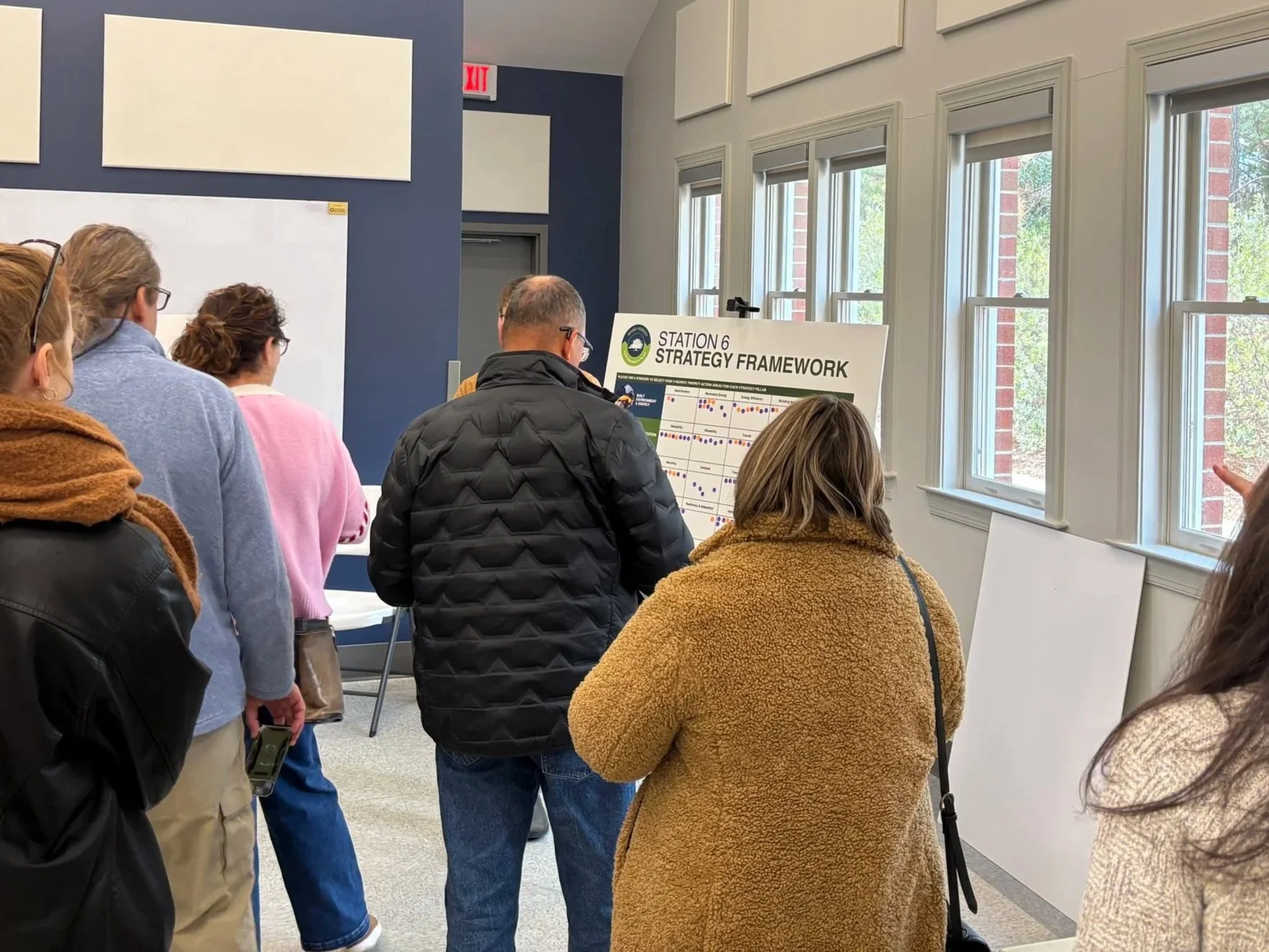
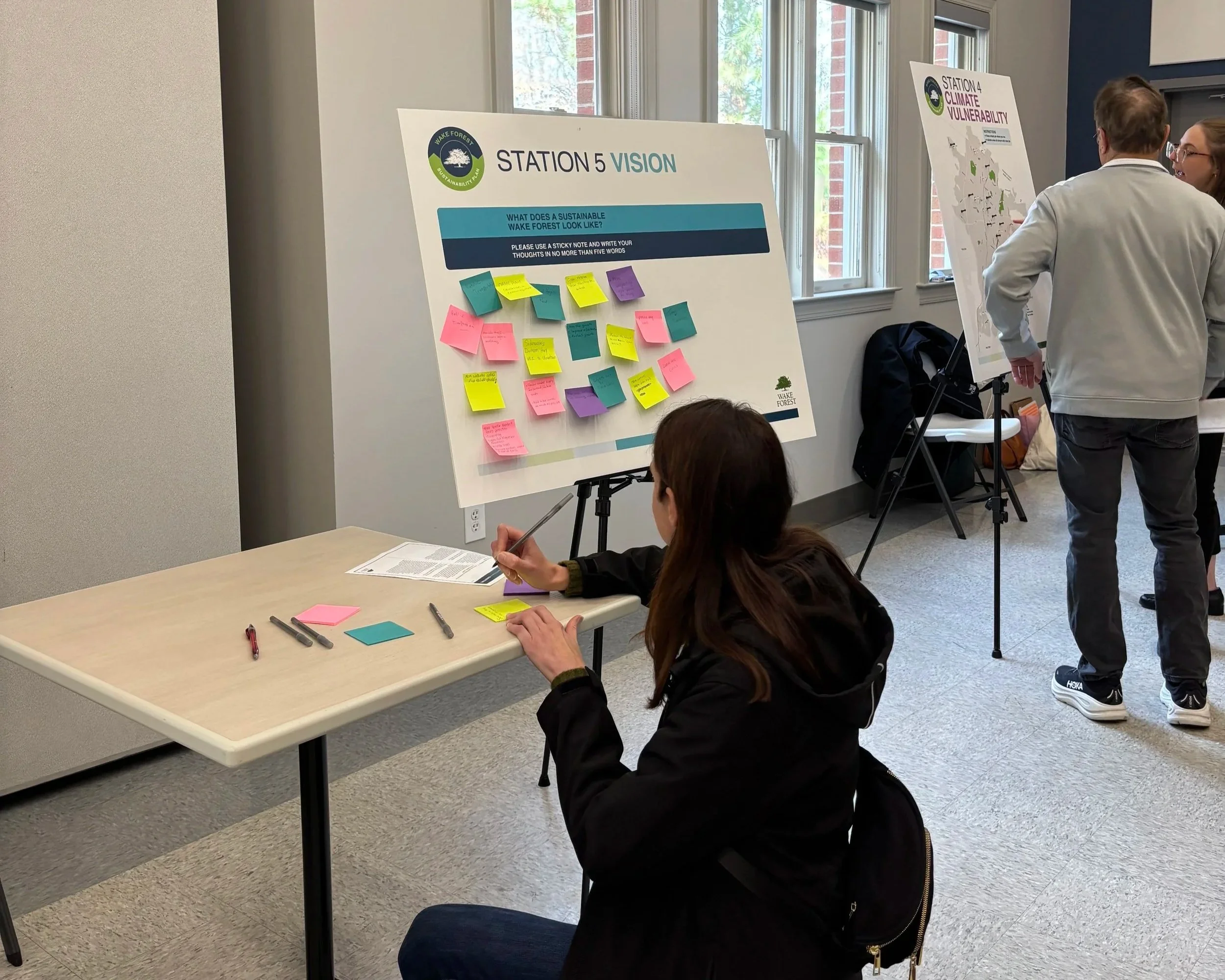
The engagement component began with a kick-off presentation and initial discussions by Town leaders. Focus groups are gathering input from civic and community groups, local businesses, and Town staff. An Open House held at the Wake Forest Center for Active Aging in early December attracted about 85 participants. “These were mostly residents, some Town employees, and some who live in unincorporated parts of northern Wake County and southern Franklin County,” Grace says. Much of the public feedback focused on conservation, habitat, flooding, and traffic concerns. “That wasn’t surprising given the feedback we’ve heard on other projects,” she adds.
A web-based survey was live from mid-December to January 30. A round of focus groups will help sharpen findings this spring as plan leaders begin considering recommendations.
Transportation issues are expected to be a part of the plan. The Town is well into implementation of a micro-transit strategy and preparation for the S-Line rail initiative, which will connect downtown Wake Forest to downtown Raleigh, several Piedmont cities, and ultimately Uptown Charlotte. Investments in the Town’s Greenways have generated strong interest from recreational users, and the sustainability plan may explore how the paths can function more broadly as pedestrian corridors.
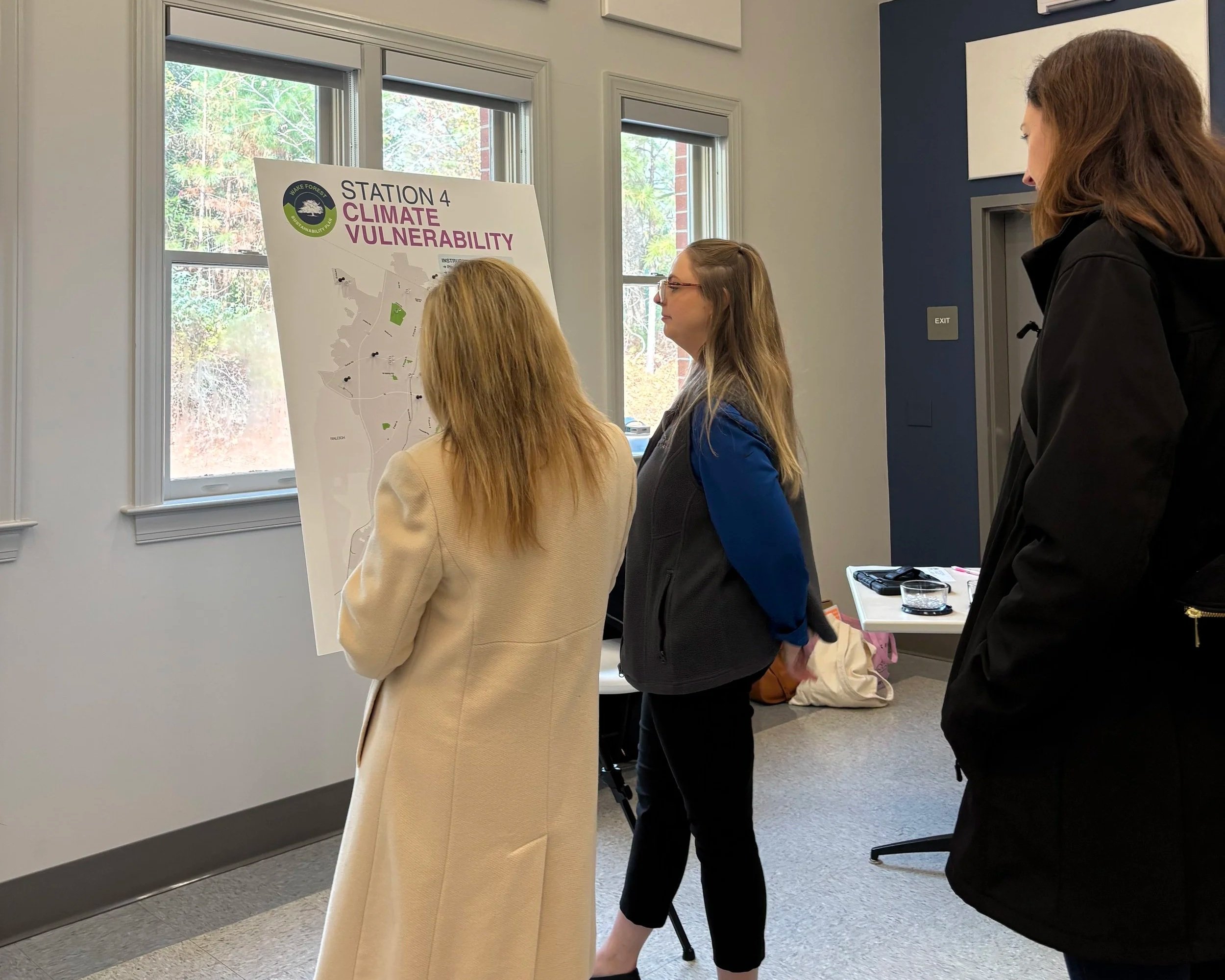
The final component is expected this summer as draft findings will be shared with the public, and another open house will guide the plan’s finalization. Town leaders are targeting completion and adoption by the end of 2026. Grace hopes the plan resonates with Wake Forest’s business community in a positive way, highlighting the Town’s proactive leadership and encouraging companies to consider how their own sustainability strategies can synthesize with those of the Town. Otherwise, the plan is unlikely to spark regulatory action aimed at the local economy. “I don’t see this as being heavily focused on setting new regulations,” Grace says.
Support for denser development, for example, is something the Planning Department has already implemented. In fact, several Town departments have pursued their own sustainability projects. The current initiative seeks to unite planning under a single strategic framework. “This is the first time Wake Forest has attempted such a comprehensive and cohesive planning effort,” Grace says, pointing to stormwater, waste disposal, and recycling, and Adopt-a-Highway as examples of Town programs that have addressed sustainability issues. “There are a lot of individual programs that we can look to, but soon we’ll have everything in one place under one vision.”