A little-known county tax on prepared food and beverages is set to drive key upgrades to the Town of Wake Forest’s outdoor recreational amenities. In February, the Wake County Board of Commissioners approved $23.5 million in grants to nine municipalities for expansion of sports, arts, and cultural facilities. Included among the 12 projects are two in Wake Forest.
The Town will receive nearly $3.9 million for the construction of the Skate Park and Pump Track and $750,000 for Phase II improvements at JB Flaherty Park. The competitive grants are derived from a six percent Hospitality Tax collected by Wake County on overnight stays, as well as a one percent levy on prepared foods and beverages. The funds are invested in capital projects that catalyze tourism spending. “These projects will help attract tournaments, performances, and cultural experiences that also generate real economic return,” says Safiyah Jackson, Vice Chair of the Wake County Commissioners.
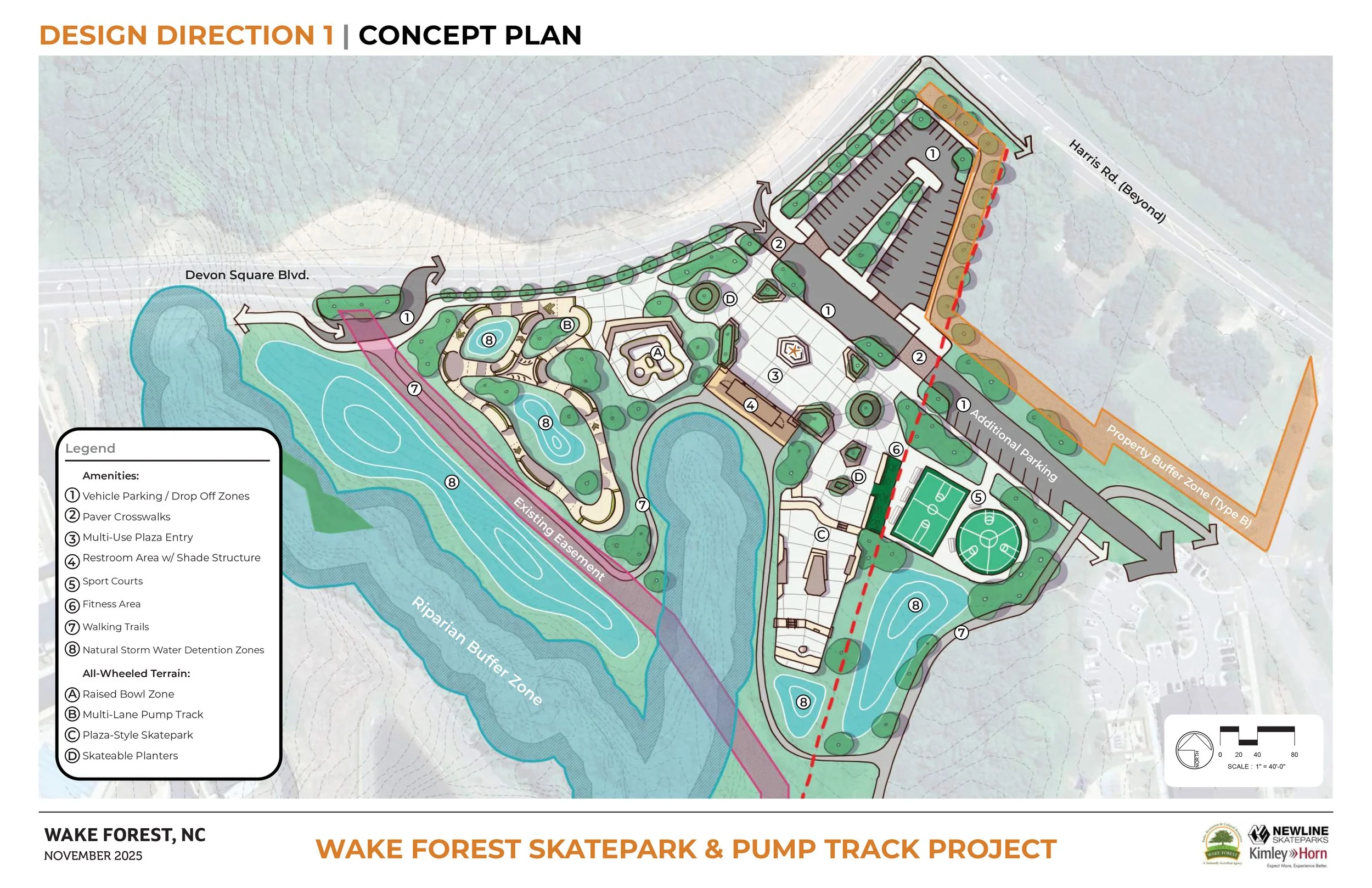
Set to be located on 8.3 acres of Town-owned land next to Joyner Park, the Skate Park and Pump Track is currently in the design and development phase. “We’ve hired New Line Skateparks to oversee the project, and they’re working with Kimley Horn,” says Ruben Wall, Director of the Wake Forest Department of Parks, Recreation & Cultural Resources. Based in Canada’s British Columbia province, New Line Skateparks is a global leader in integrated concrete skateparks, pump tracks, and other recreational sporting environments. The firm’s landscape architects and engineers will collaborate with Kimley Horn’s team of community planners and technical experts in designing the new park and track. “Then we’ll take it out for construction bids later this year,” Wall says.
Both parks will accommodate users of all ages. The skatepark will attract skateboard and roller-blade enthusiasts, while the pump track is for cyclists. Both will also host competitive tournaments that will draw outside visitors to Wake Forest. A series of well-attended public meetings over the last two years drew citizen input into the vision for both assets. “They love it,” Wall says of public support for the initiative. Both facilities will operate free of charge, complementing nearby basketball courts and exercise equipment to boost interest in outdoor fitness. “It’s part of offering a variety of things that people can do,” Wall says. While such assets are not uncommon in public spaces, “it’s unusual to have a combination of the two in one place,” he adds. Wall hopes to have the skatepark and pump track completed by the end of 2027.
Phase II improvements at Flaherty Park are set to begin in the coming fiscal year. The initial phase, completed in 2024, was driven by a mix of funding from the state and the Town. The Wake County grant will help with the $3.4 million total cost of Phase II. “That’s going to complete the rest of the park,” Wall says. “Our goal is to have consistent quality across all three fields.” He expects Phase II to be completed by mid-2028.
Home to the Wake Forest FUNGO, Flaherty Park is already an economic development asset. The collegiate summer baseball team, now in its 10th season, partners with the Town in bringing spectator sports to the park. “That’s our town’s sponsored team,” Wall says. Along with promising athletes and “wood bat” baseball fans, the FUNGO brings direct economic impact in the form of ticket and merchandise sales, as well as food and beverage revenues. The team also organizes themed entertainment, camps, clinics, and group packages. The presence of the FUNGO was instrumental in winning the county grant, says Wall. “Those fields will be upgraded, and we’ll have more people using those facilities, along with better games and a higher quality of play,” he predicts.
Julie Kruse-John, Vice President for Operations & Public Affairs at the Wake Forest Area Chamber of Commerce, says, “There is endless opportunity with the improvements at Flaherty Park.” While FUNGO athletes are mostly local, “every year we host several from across the country as well as Canada,” she says. “Not only does this bring their families and friends into Wake Forest to visit, but every player attends and plays for colleges around the country, which connects our town to their hometowns and brings in their collegiate networks as well,” Kruse-John says.
The last time Wake Forest received funding from Wake County’s Hospitality Tax was 2017, when it provided $350,000 to support renovations at the Renaissance Center. Though the tax is levied county-wide, the bulk of the funds have supported projects in the City of Raleigh and the Town of Cary. That may soon change as state legislative leaders forge solutions for a more equitable distribution to Wake County’s other municipalities. The taxes, which were levied in 1991 through authorization by the North Carolina General Assembly, have driven the development of large venues like the Raleigh Convention Center and the Lenovo Center.
“The county raises an estimated $92 million per year,” according to N.C. Rep. Mike Schietzelt, whose legislative district stretches across northern Wake County. “As exponential growth has come to Wake Forest, our prepared food and beverage revenue has also grown significantly,” Rep. Schietzelt says. The current annual projection is about $2.5 million. Rep. Schietzelt and Rep. Erin Paré, whose southern Wake County district includes Holly Springs and Apex, are working on legislation to address structural inefficiencies in the revenue mechanism. Among other objectives, their efforts aim to secure funding streams for all municipalities that are producing revenues that can be used for local tourism projects.
“There’s a significant tourism angle to it,” Rep. Schietzelt says, pointing to the FUNGO and other competitive sporting events that can draw outsiders to Wake Forest. “It’s something that can bring a lot of visitors to the area.” Youth sports in particular drive a lot of travel teams, he says. As far as legislative action goes, “there are a lot of moving pieces to this,” Rep. Schietzelt says, noting that conversations among county and municipal staff have been ongoing for over a year. “We’re trying to get everyone to the table and see if we can make this all work,” he adds, confident that a satisfactory solution is on the horizon. “There have been a lot of questions at this stage,” Rep. Schietzelt says. “We’ve made great progress in at least answering the questions.”
The result could mean a reliable annual revenue stream of $1.25 million that could secure bonds to build major assets like a performing arts center, amenities that would fuel additional spending on hotel rooms, restaurant meals and prepared beverages. “It would begin to feed off itself, and that would spark exciting opportunities around our Town’s hospitality and tourism sector,” says Jason Cannon, President of the Wake Forest Business & Industry Partnership (WFBIP). Cannon believes the Town’s eclectic array of food and drink establishments already delivers great benefits for the local economy in terms of quality-of-life appeal. “We need more of the county revenues these businesses generate to be re-invested closer to home, and I commend Rep. Schietzelt on getting this significant economic development issue out on the table.”