Each year, the Wake Forest Community Profile offers a clear, data-driven snapshot of how our town is evolving.
Wake Forest is a vibrant, thriving community in North Carolina’s renowned Research Triangle Region, just minutes from downtown Raleigh. Powered by engaged residents, innovative businesses, and driven entrepreneurs — and underpinned by a strong local economy — the town continues to grow with purpose and momentum. Recently hailed as “THE BEST SUBURB TO MOVE TO IN THE U.S. RIGHT NOW” by Travel + Leisure, Wake Forest is known for its strong appeal to young professionals and families, delivering big-city energy while preserving its warmth and palpable small-town charm.
The 2026 Community Profile reinforces what residents, entrepreneurs, and employers already know: Wake Forest remains one of North Carolina’s most dynamic communities, pairing strong economic fundamentals with a high quality of life that continues to attract talent and investment.
Wake Forest now ranks in the top 3% of municipalities across North Carolina, reflecting years of intentional planning and sustained momentum. With an estimated population of 64,618 in 2026, the town continues to grow at a steady pace, welcoming an average of 7 new residents each day and marking a 4.25% increase from 2025 to 2026.

“Wake Forest isn’t just growing, it’s growing with purpose,” said Jason Cannon, President of the Wake Forest Business and Industry Partnership (WFBIP). “This year’s data reflects a community that’s investing in people, businesses, and infrastructure in ways that support long-term success.”
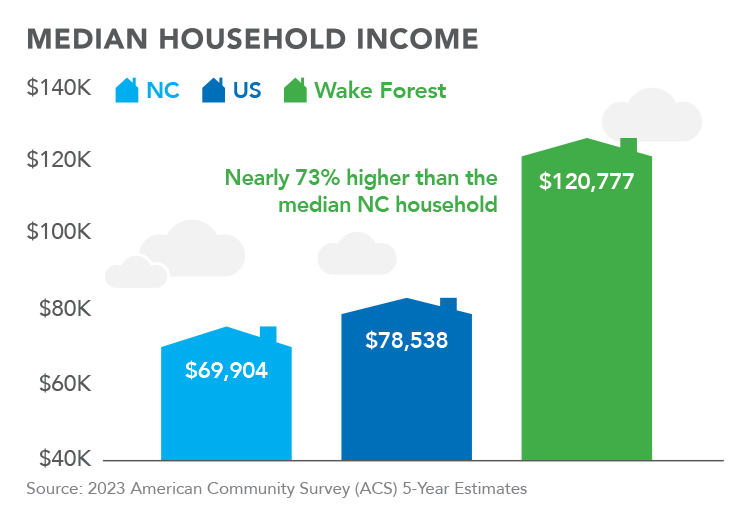
Economic strength remains a defining characteristic. Median household income in Wake Forest has reached $120,777, nearly 73% higher than the North Carolina median, underscoring the town’s appeal to professionals, families, and employers alike. Within a five-mile radius, median household income exceeds $132,000, further reinforcing Wake Forest’s role as a regional economic driver.
Together, these indicators point to a community that offers both stability and scalability. Strong household incomes support a resilient consumer base, while sustained population growth and workforce availability create favorable conditions for long-term business expansion across industries.
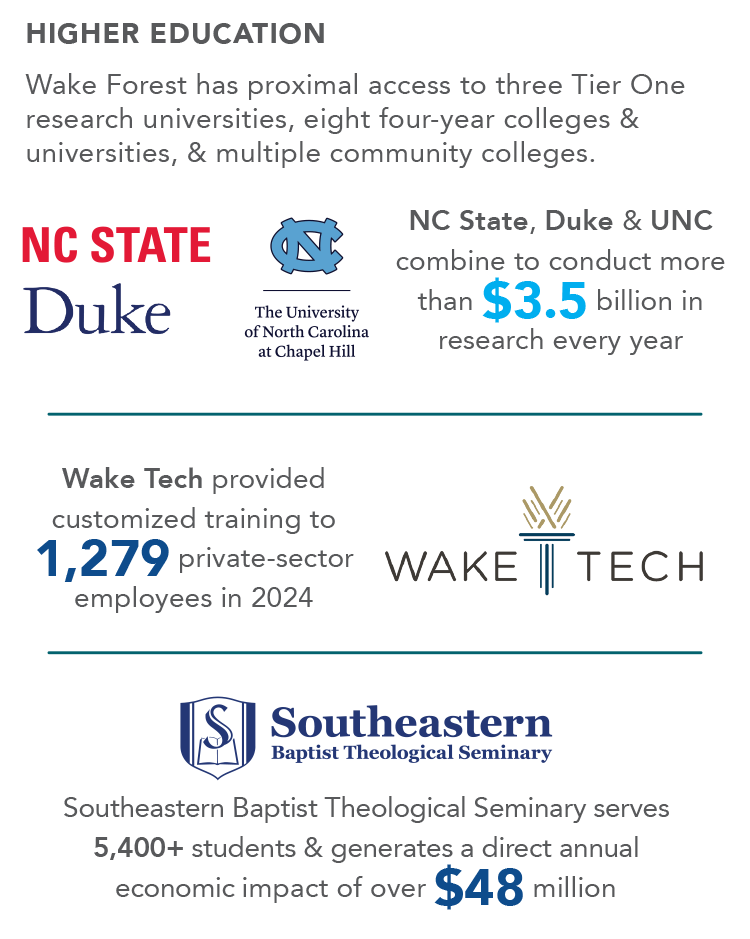
Workforce access and educational attainment continue to distinguish the community. Nearly 58% of Wake Forest residents hold a bachelor’s degree or higher, and employers benefit from proximity to three Tier One research universities — NC State, Duke, and UNC-Chapel Hill — which together conduct more than $3.5 billion in research annually. More than 279,000 workers are available within a 10-mile radius, providing both depth and diversity of talent.
“When you combine a highly educated workforce with sustained population growth and strong household incomes, it creates an environment where businesses can scale with confidence,” Cannon said. “Those fundamentals are a big reason companies continue to choose Wake Forest.”
Development activity remains steady and strategic, supported by continued investments in infrastructure and mobility. Major transportation assets, including easy access to RDU International Airport, regional transit services, and the federally funded S-Line passenger rail project connecting Raleigh to Wake Forest, position the town for long-term connectivity and economic resilience.
Entrepreneurship also continues to thrive. More than 175 startups have been supported through Wake Forest’s entrepreneurial ecosystem, including Wake Forest Founders, the Wireless Research Center, the Wake Forest Area Chamber of Commerce, and Loading Dock - Wake Forest. Together, these organizations help cultivate innovation, support small businesses, and strengthen the local economy.
Taken together, the 2026 Community Profile tells a clear story: Wake Forest is growing, not just in size, but in opportunity. With strong demographics, a skilled workforce, expanding infrastructure, and a collaborative business environment, the town remains well-positioned for continued success in the years ahead. For the Wake Forest Business & Industry Partnership, the Community Profile serves as both a benchmark and a planning tool, guiding economic development efforts aligned with the community’s continued momentum.